In brief
- Reap advertises Visa principal-issuer status in Hong Kong and Mexico; it names no legal issuing entity, and for the 100-plus markets announced with Visa on 23 September 2026 the applicable authority is not stated.
- Reap documents two funding models fixed at setup: Reap-provisioned per-user wallets, or partner-held funds with a separately topped-up master collateral account. The documentation does not establish the legal custodian, key control or protection of either.
- Deposits are limited to USDC and USDT; Reap publishes no country eligibility list, no card-issuing price and no cardholder agreement naming an issuer.
Reader question: if I want to launch a stablecoin-funded card programme, what does Reap actually give me, whose licence does it run on, and where do user funds sit?
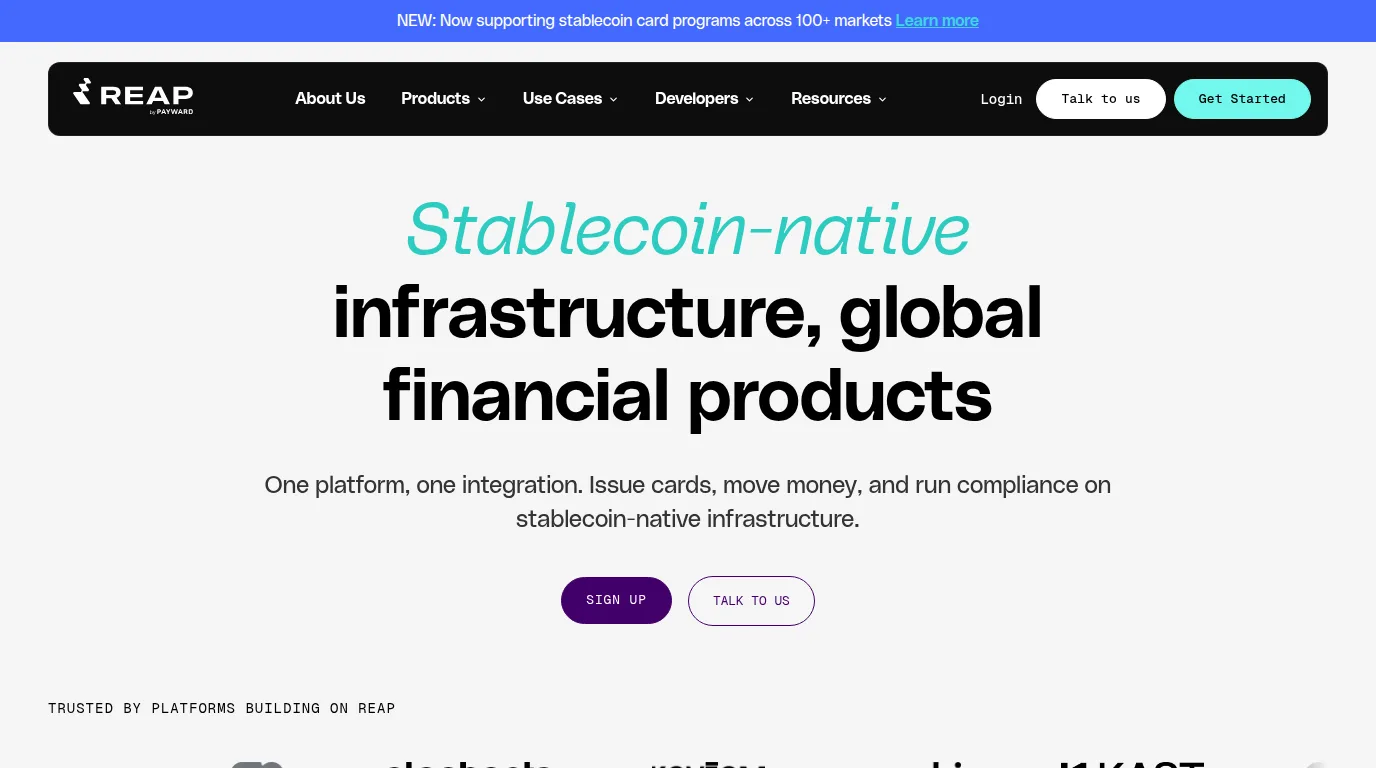
Reap sells the plumbing behind other companies’ cards: network authorisation, processing, compliance and programme operations, so a fintech or wallet can issue cards that are funded and repaid in stablecoins. The documentation is unusually specific about where balances sit; the corporate paperwork is unusually quiet about who is legally on the hook. Payward, Kraken’s parent, announced on 1 July 2026 that it had completed its acquisition of Reap Technologies Holdings Limited and that Reap keeps its own name and leadership; how that acquired holding company relates to the entity named on Reap’s website is not established. This profile establishes which parts are documented and live, which are announced, and which questions the published material leaves open for anyone comparing card-issuing platforms.
What is verified today
Documented and marketed; production status not verified: the white-label card-issuing platform. Reap’s developer documentation sets out funding models, programme modes, supported assets and a configurable cardholder fee schedule, all checked on 23 September 2026, but documentation describes an offering rather than evidencing live programmes, and Reap names no client running one.
Published, for Reap’s own cards: free physical and virtual cards, 2% ATM, 2% FX, USD and HKD billing, and a credit limit equal to 100% of collateral. That is evidence about Reap’s own card product, not about third-party programmes on the platform.
Announced, not verified as live: the Visa collaboration of 23 September 2026 covering more than 100 markets, and the Virtual Asset Ledger announced on 22 September 2026, which converts a user’s bitcoin or other asset balance at the point of sale instead of requiring a prior swap. Neither announcement names a market where a programme is live or a client running the ledger.
Company-reported, not independently verified: “2M+ Cards issued” and “8+ years in the card issuing business”, as stated on the card-issuing page. The page gives no period for the count, does not say whether the cards are active, and does not split its own card product from third-party programmes, so the figure sets a scale but does not evidence current usage.
Entity and authority
| Item | What the sources say |
|---|---|
| Brand | Reap |
| Named entities | Reap Technologies Limited (website and privacy policy) and Reap Technologies Holdings Limited (the company Payward acquired). Neither source states how the two relate, and no corporate-register search is documented, so the entity chain between the acquired company, the contracting business and the marketed platform is unverified. |
| Owner | Payward, Inc., parent of Kraken, announced completion of the acquisition on 1 July 2026 (the acquirer’s own announcement; not independently corroborated). The OCC’s published table lists an application from Payward National Trust Company, received 05/08/2026; the table does not state that entity’s relationship to Payward, Inc. or to Reap |
| Card scheme position | The card-issuing page advertises “Visa Principal Issuer Hong Kong and Mexico. Credit BINs.” It does not name the legal entity holding that membership |
| Issuer of record | Not verified. We found no cardholder agreement, programme terms or issuer disclosure on reap.global or in the documentation index |
| Hong Kong money service register | A search of the Hong Kong Customs money service operator register on 25 September 2026 returns REAP (REMIT) LIMITED, 28/F, 1063 King’s Road, Quarry Bay. The register does not connect that entity to Reap Technologies Limited or to the Reap brand, and the results list shows no licence number |
| Other markets | Not verified. The published material does not describe the licence position for markets outside Hong Kong and Mexico |
For a buyer, that is the open question. Reap’s page says its principal-issuer status means a client can “launch on Reap’s licence without applying for your own”; that is Visa scheme membership, not a statutory licence or a permission to issue in every market, and Reap advertises it without naming the entity that holds it or the arrangement elsewhere. The Payward announcement also does not say that Payward’s own licences extend to Reap.
Product scope, availability and eligibility
Deposits are limited to USDC issued by Circle and USDT issued by Tether. Chains depend on the funding model: Base, Polygon and Solana for user deposits, Ethereum, Polygon and Solana for master collateral. The documentation warns that any other token, including native ETH or SOL, does not count toward a spending balance.
Programme mode is fixed before integration: Consumer mode verifies each user, Corporate mode requires KYB on the company plus KYC on each individual, and Reap says neither mode nor funding model can change after launch. Cardholder fees are the programme’s own: FX markup and domestic or cross-border ATM fees, variable or fixed, set as project defaults in the dashboard by an organisation admin.
What is not published: any list of countries where a business can contract, where cards may be issued, or where cardholders may reside. We checked the card-issuing page, the pricing page, the terms of use and the programme-mode documentation. Card-issuing pricing is quoted by sales.
Where the money sits: the two funding models
| Step | User-Funded (default) | Program-Funded |
|---|---|---|
| Where the balance sits | In a per-user wallet Reap provisions. The documentation says “their balance stays self-custodied and isolated to that user”, which describes the arrangement without naming a legal custodian | User funds: “Your custody, off Reap”. The master collateral account is kept “with us”, and Reap lists “multi-chain stablecoin custody for the master account” among its services |
| Legal custodian, key control, segregation | Not stated in the documentation | Not stated in the documentation |
| What backs a card swipe | That user’s own wallet balance | A single master collateral account the partner tops up |
| Deposit chains | Base, Polygon, Solana | Ethereum, Polygon, Solana |
| Authorisation | Reap authorises against the account’s available balance | Set separately: Reap authorises against balances the partner keeps in sync (Managed), or the partner’s own systems approve each transaction in real time (External). The documentation says this setting applies only to Program-Funded projects |
| Settlement | “On a schedule, Reap settles cleared card spend by drawing stablecoins from the user’s wallet” | Reap settles with the card network; cleared spend is reconciled against the master collateral account, and the partner settles with its own users “on your own cadence” |
| Fits | Retail cards where each user funds their own spending | Custodians, exchanges, wallets, brokerages and corporate treasuries that already hold user funds |
Source for every row: Reap’s funding-model, authorisation-mode and supported-asset documentation, checked 23 September 2026 and again on 1 October 2026, quoted where the wording matters. The documentation describes where balances sit and who tops them up; it does not identify the legal custodian, who controls the keys, how balances are segregated, or what happens on insolvency. The choice is irreversible after launch, which makes it the first question to put to Reap, not the last.
Dependencies
Visa, for scheme membership and acceptance. Payward, as owner. Circle and Tether, since only their two tokens are credited. Base, Polygon, Solana and Ethereum, for deposits. An unnamed issuing entity, since none is disclosed. Reap’s 23 September release adds a dependency in the other direction: it says Reap is a partner in Visa’s stablecoin settlement programme in Asia Pacific, and that settling with Visa in stablecoins runs beyond banking hours and reduces the pre-funded balances issuers must hold. That is the company’s description, not a verified production flow.
Alternatives
| Dimension | Reap | Rain | Baanx |
|---|---|---|---|
| Where user funds sit | Reap-provisioned wallets or partner custody, fixed at setup; legal custodian not named | States in its dashboard agreement that it is not a custodian and has no control over wallet assets | A MetaMask statement on its site calls that card self-custodial; other programmes not verified |
| Country restrictions published | No | Yes: 17 countries excluded for cardholders, 7 for spending | None found on its homepage, checked 1 October 2026 |
| Named live programmes | None named | MoneyGram Card, per Rain’s own site | A MetaMask card, per a partner statement on its site; status not stated |
| Named contracting party and issuer | Neither published | Signify Holdings, Inc. contracts; Third National issues the Rain Spend card under Visa licence | Site operator named as Baanx.com Ltd; card issuer not named on its homepage |
| Licence position stated | Principal-issuer status advertised for Hong Kong and Mexico; entity not named | Issuer named for its own card; per-region issuers not published | Its site footer says Baanx.com Ltd is registered with the FCA as a cryptoasset business under the Money Laundering Regulations (927401); that is an anti-money-laundering registration, not a card-issuing licence |
The Rain and Baanx cells above are quoted from those companies’ own agreements and sites, each recorded in our claim ledger with the passage and retrieval date; the Baanx row rests on a single MetaMask statement hosted on its site, so treat it as that statement rather than as a description of every Baanx programme. Among the sources checked, Rain publishes cardholder and spending exclusions and names a dashboard counterparty; its own-card terms also name an issuer, which does not establish issuer coverage or contracting eligibility for every white-label programme. If you want principal-issuer status advertised for Asia or Mexico, Reap is the one claiming it, though not the entity behind it. Baanx hosts a MetaMask statement describing that card as self-custodial; we did not verify its other programmes.
Limitations and unknowns
- Country eligibility for contracting, issuing and cardholder residence: not publicly disclosed (checked card-issuing, pricing, terms of use and programme-mode pages).
- The legal entity holding the Visa principal-issuer membership, the issuer of record for programmes, and the arrangement outside Hong Kong and Mexico: not yet verified (checked the card-issuing page, terms of use and the documentation index; no cardholder agreement or issuer disclosure found).
- Legal custodian, key control and segregation of the wallets Reap provisions: not yet verified.
- Whether any third-party programme is live on the platform today: not yet verified; no client is named.
- Which Reap entity holds the master collateral account (the documentation says it is kept “with us”), who controls its keys, and how it is treated on insolvency: not yet verified.
- Which entity converts stablecoins for network settlement, which banks and processors sit behind it, and whether any deposit insurance or other customer-funds protection applies: not publicly disclosed (checked the funding-model, authorisation-mode and supported-asset documentation on 1 October 2026).
- Whether REAP (REMIT) LIMITED, found in the Hong Kong money service operator register on 25 September 2026, belongs to the same group as Reap Technologies Limited: not yet verified; the register gives a name match and an address, not a corporate link. The OCC table was checked: it lists an application from an entity named Payward National Trust Company, whose relationship to Payward, Inc. or to Reap the table does not state.
- Card-issuing pricing: not publicly disclosed; only Reap’s own card and payout pricing is published.
- Whether Payward’s US and EU licences extend to Reap programmes: not yet verified; the completion announcement does not say so.
- Relationship between Reap Technologies Limited and Reap Technologies Holdings Limited: not yet verified; the privacy policy and the acquisition notice name different entities and neither explains the link.
- Named clients running the Virtual Asset Ledger: not publicly disclosed.
Key facts (as of 1 October 2026)
- Subject: the Reap business, stablecoin-native card issuing and payments infrastructure sold to other companies
- Founded: in Hong Kong, where it is headquartered (founding year not stated in the sources checked); about 300 staff as stated in the 1 July 2026 completion announcement
- Owner: Payward, Inc.
- Scheme position: advertises Visa principal-issuer status, Hong Kong and Mexico, credit BINs; entity not named
- Assets accepted: USDC, USDT
- Chains: Base, Polygon, Solana (user deposits); Ethereum, Polygon, Solana (master collateral)
- Own card pricing: 2% ATM, 2% FX, USD and HKD, collateral 1:1
- Website: reap.global | X: @reapglobal
Sources
- Reap product and policy pages: card issuing, pricing, privacy policy
- Reap developer documentation: funding models, authorisation mode, supported assets, programme modes, fees
- Payward: completion of the Reap acquisition, 1 July 2026
- Reap and Visa announcement, 23 September 2026, and Virtual Asset Ledger, 22 September 2026
- Comparison sources: Rain prohibitions list, 18 August 2026 and Baanx partner statements
Last updated: 1 October 2026 (sources and news rechecked; no material change since 23 September). Next recheck triggered by: a published country eligibility list, a change to the Visa principal-issuer footprint, named Virtual Asset Ledger clients, or a change to the funding-model documentation.