In brief
- M0 is both: a Swiss foundation that runs the website and publishes the docs, and an on-chain protocol where permissioned institutions (“minters”) pledge off-chain collateral and mint the $M dollar token that branded stablecoins are built on (website terms; roles docs).
- On Ethereum mainnet, four minters were active on 28 September 2026. The address M0’s own API documentation identifies as MXON accounted for 78.7% of the four minters’ combined 198.84 million $M of minter debt (our read of the MinterGateway contract at block 26078640). That is minter debt, not the supply of any branded token.
- Three of the four minters, the validator set, the legal entity that sells M0’s licences and the issuer of record for any specific M0-powered token are not named in the M0 sources we checked.
Reader question: is M0 a protocol, a company or both, and who can actually mint?
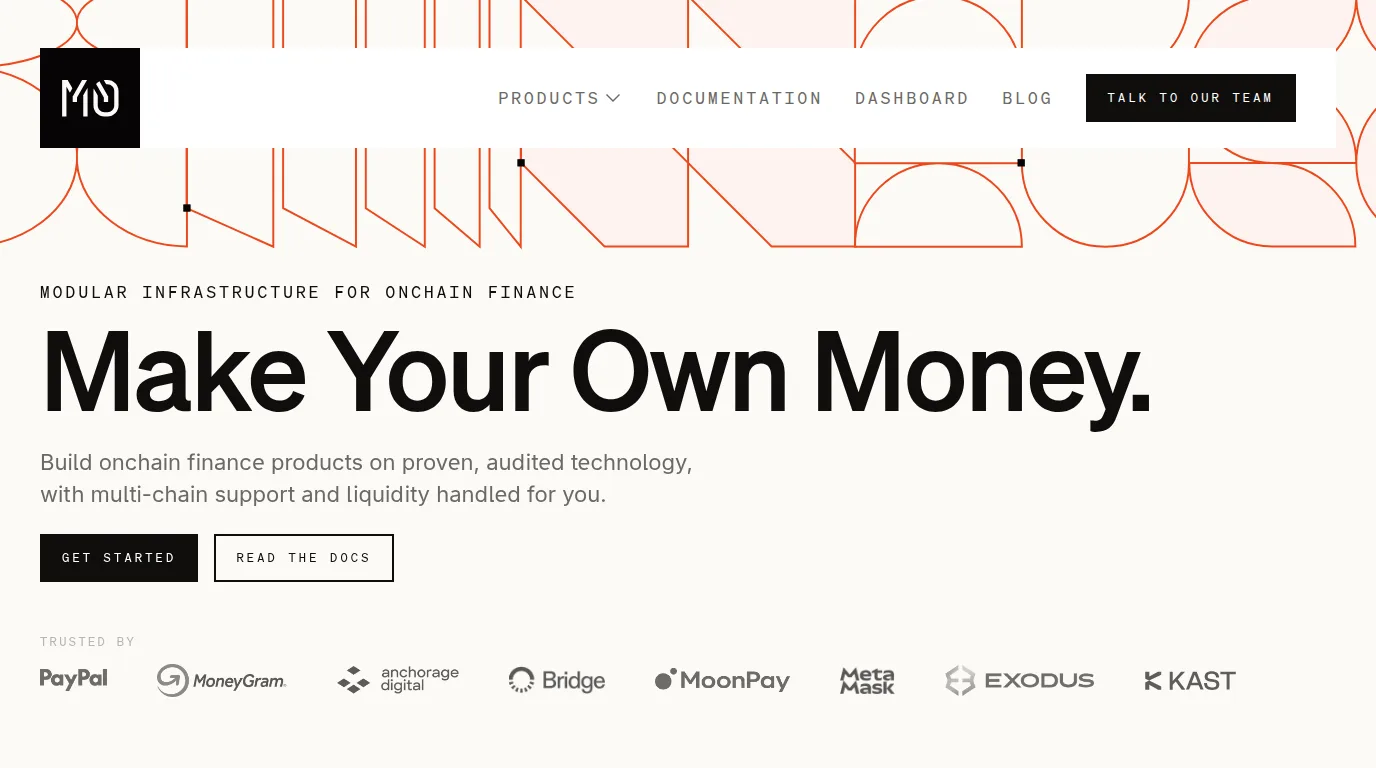
M0 describes itself as infrastructure for application-specific dollar stablecoins. Status by component: the $M protocol is observed operating on-chain (below); Stablecoin Core, Onchain Orchestration and PYUSDx are company-described, and their live availability is not verified. In M0’s description, a builder designs a token and a regulated institution pledges collateral and mints it (how it works). The same page lists Bridge (Stripe), MoonPay and 1Money among issuers, and PayPal, MetaMask and Kast among builders, under the heading “Trusted by”. This profile separates the entity from the protocol, reads the minter list directly from the chain, and sets out which parts of “who can mint” are decided by governance, which by validators, and which remain undisclosed. Those names are company-listed relationships: they do not tell us which company runs a production deployment or which of the four on-chain minters, if any, belongs to them, and we have not confirmed them with the companies.
What is verified today
- Live, on-chain (verified by us): the MinterGateway contract 0xf7f9…F04E is listed on M0’s deployments page. It has emitted MinterActivated events for four addresses since 16 May 2024, the latest on 5 January 2026 (Blockscout logs, read 28 September 2026). We did not keep raw negative queries for deactivation or freeze events, so we rely on current state instead: all four returned isActiveMinter = true, isFrozenMinter = false and isDeactivatedMinter = false at block 26078640 (21:28 UTC, 28 September 2026).
- Company-described; live availability not verified: PYUSDx, which M0 calls a developer platform built around PYUSD. Partners do not offer PYUSDx to users; they create their own token “backed 1:1 by PYUSDx”, and M0 operates the shared layer (PYUSDx docs). We have not traced a live partner token on-chain.
- Company-reported: the audits page lists core-contract reviews from December 2023 to April 2024 by eight firms or reviewers (Quantstamp, Three Sigma, Certora, ChainSecurity, OpenZeppelin, Prototech Labs, Kirill Fedoseev, Sherlock), wrapper reviews in July-August 2024 and a Certora review of the M extension in July 2025 (audits page). We did not read the reports or check whether they cover today’s deployments.
Entity and authority
The website terms (last updated May 2024) say the site is owned and operated by M0 Foundation, a foundation under Swiss law domiciled at Bergliweg 15, 6300 Zug; the terms are governed by Swiss law with arbitration seated in Zurich. The terms establish who runs the website, not who sells M0’s products. The docs, which say “M0” throughout, describe a protocol governed by two tokens: POWER holders vote to approve minters, validators and earners and to set rates and collateral ratios; ZERO holders claim a pro-rata share of protocol revenue and vote on fundamental changes such as upgrading the governance contracts (roles). Whether the foundation or its affiliates hold governance tokens was not checked.
- M0 Foundation: website operator, per its terms.
- Seller of Stablecoin Core and Onchain Orchestration licences; operator of the PYUSDx proxies: described only as “M0”; legal entity not yet verified.
- Protocol and $M: smart contracts run by POWER and ZERO governance; not a legal person.
- Minters: permissioned institutions holding collateral in SPVs; one named (MXON), three not publicly disclosed.
- Issuer of each branded token: not publicly disclosed.
M0 does not claim a licence of its own. Its docs say it is built for institutions that “already operate, or are ready to operate” with the appropriate licences and charters, and that the issuer manages the reserve side while “M0 gives you the tech” (issuers overview). No licence or registration for any M0 entity appears in the M0 sources we checked (website, terms, docs, 28 September 2026). The docs place licensing with the issuing institutions; three of the four minters are unnamed, so their licences cannot be checked.
Product scope, availability and eligibility
A Stablecoin Core is specific to one issuer and one currency. Onchain Orchestration, which M0 says lets an issuer swap USDC for its stablecoin, convert within and across issuers and move tokens across chains, is “available as an additional license on top of Stablecoin Core” (issuers overview). Collateral is “permissible investments in line with local regulations”, described elsewhere as typically US Treasury bills held in special purpose vehicles. Only governance-approved Earners receive the earner rate. Any $M holder can burn $M against a specific minter’s debt; for a deactivated minter the docs call this an informal liquidation mechanism. Burning reduces that debt and is not a fiat redemption right. The docs describe minters as the primary fiat on- and off-ramp; redemption eligibility, timing and fees for holders of any M0-powered token are not publicly disclosed (minting and burning). M0 publishes no list of countries where a business can contract or where a token may be launched, no pricing and no customer eligibility rules beyond the licensing expectation above: not publicly disclosed.
Who can mint: the control path and the live minter set
For $M, the docs describe one mint path: governance approves the minter; the minter holds collateral off-chain in an SPV and posts its value on-chain; the minter proposes a mint; a governance-set delay (MINT_DELAY) runs during which validators may cancel it or freeze the minter; the mint must be executed before the proposal expires (MINT_TTL). This analysis establishes the documented $M minting path only; we have not verified how that path relates to Stablecoin Core or PYUSDx. A minter that misses its collateral update interval has its on-chain collateral value set to zero and incurs a penalty rate (glossary).
| Minter address | Public name | Activated | Owed $M | Share | Posted collateral above owed |
|---|---|---|---|---|---|
| 0x7f74…5446 | MXON (M0 API docs) | 16 May 2024 | 156.54M | 78.7% | 0.7% |
| 0xcd13…9d74 | Not publicly disclosed | Aug 2025 (3 events) | 30.65M | 15.4% | 6.1% |
| 0x5d23…d5d9 | Not publicly disclosed | 5 Jan 2026 | 10.81M | 5.4% | 2.1% |
| 0x1d5b…b249 | Not publicly disclosed | 8 Dec 2025 | 0.84M | 0.4% | 6.1% |
Method: MinterActivated logs via the Blockscout logs API; activeOwedMOf and collateralOf via eth_call at block 26078640, 6 decimals. “Posted collateral above owed” is collateralOf divided by activeOwedMOf, minus one. Collateral figures are the values minters report on-chain, not an independent check that the reserves exist. The ratio is not remaining minting capacity, because we did not read the governance mint ratio. Owed $M is minter debt, not the circulating supply of any branded token. The script and every raw request and response are kept with our claim ledger.
Dependencies
Minters (fiat access, SPV custody of collateral); validators (collateral verification, emergency powers; addresses not yet read, operators not identified in the M0 docs checked); POWER and ZERO governance; Ethereum and the chains each token extends to. For PYUSDx, M0 operates the core contracts behind transparent proxies, and custom tokens follow M0’s latest audited implementation unless the partner pins a version; those tokens carry freezing, forced transfer from frozen accounts and pausing (PYUSDx docs). The SPV custodians and attestation arrangements for each minter are not publicly disclosed.
Alternatives
| M0 ($M minting) | Brale (Creator Digital Asset) | Agora (AUSD; Customer-Issued white-label) | Paxos (USDP, PYUSD) | |
|---|---|---|---|---|
| Who issues | Governance-approved minters; issuer of record per branded token not named | Agreement does not name an issuer; Brale deploys the contracts (BUA) | AUSD: Agora Bermuda Limited. Customer-Issued token: the sponsor (terms) | Terms name Paxos Trust Company, NA as the managing entity for both (not stated as issuer of record in the passage we hold) (terms) |
| Where reserves sit | Minter SPVs, “typically” T-bills (docs) | “Generally” in accounts titled to Brale (BUA) | AUSD: managed by VanEck, custodied by State Street (Agora docs) | Segregated accounts at regulated institutions, apart from corporate funds (terms) |
| Register evidence | No register searched: no licence claim for an M0 entity in the website, terms or docs checked on 28 Sep 2026. Minters’ permissions are separate | Company-reported US state money-transmitter licences could not be verified (28 Sep 2026) | AUSD issuer: BMA Class F, reg. 202504895 (BMA). Does not extend to a sponsor | OCC trust charter 25379 (OCC list, 31 Aug 2026) |
| Redemption | Through minters; burning only reduces a minter’s debt | If Brale stops holding reserves, the creator must arrange redemptions (BUA) | AUSD: verified Agora customers only | Paxos Customers only |
The difference is structural. M0 is a multi-minter system: several institutions mint the same base token against their own collateral, under token-holder governance. Agora names Agora Bermuda Limited as the issuer of AUSD, and we verified its BMA entry; Paxos names Paxos Trust Company, NA as the entity managing USDP and PYUSD, and we verified its OCC charter listing. Brale runs the issuance for you under its own agreement. A licensed institution that wants to mint against its own collateral fits M0’s model; a business that wants a single, register-checked counterparty behind the dollar fits Paxos or AUSD itself. A trust charter or reserves held at regulated institutions do not by themselves make any of these tokens insured.
Limitations and unknowns
- Issuer of record for $M and for each M0-powered token: not publicly disclosed (checked the docs and website terms).
- Identity of three of four active minters: not identified in the sources checked (Blockscout labels, M0 docs and API recipes), tagged not publicly disclosed.
- Validator addresses; current mint ratio, minter rate and earner rate: not yet verified. The Protocol API needs a key; reading them from the governance contracts is the next step.
- Validator operators: not publicly disclosed in the M0 docs checked (roles page, 28 September 2026).
- Deposit insurance or any other protection for holders of M0-powered tokens: not publicly disclosed (checked the issuers overview, roles and minting-burning pages, 28 September 2026). We make no finding either way.
- Legal entity that sells M0’s licences and operates PYUSDx: not yet verified (the website terms name only the site operator).
- Where a business can contract with M0, where an issuer may launch a token, pricing, onboarding, holder redemption terms, SPV custodians and attestation arrangements: not publicly disclosed (checked the issuers overview, roles, minting-burning pages and website, 28 September 2026).
- Any licence held by an M0 entity: not publicly disclosed in M0’s website, terms or docs; no regulator register was searched, because no licence is claimed.
- Named customers’ production use, and whether the audits cover today’s deployed contracts: not yet verified.
- We read Ethereum mainnet only; minters on other chains were not checked.
Key facts (as of 28 September 2026)
- Website operator: M0 Foundation, Zug, Switzerland (terms, May 2024).
- Active mainnet minters: 4, none frozen (block 26078640).
- Combined minter debt: 198.84M $M; largest minter’s share 78.7% (block 26078640).
- Governance tokens: POWER (operations), ZERO (revenue, fundamental changes).
- Audits listed: core contracts Dec 2023-Apr 2024 (eight reviewers), later wrapper and extension reviews.
Sources
- MinterGateway on Blockscout and Etherscan (read 28 September 2026).
- M0 documentation: how it works, roles, minting and burning, issuers, PYUSDx.
- M0 website terms.
- Comparison sources: Brale Business User Agreement; Agora terms and BMA register; Paxos stablecoin terms and the OCC active trust bank list (31 August 2026).
Last updated: 28 September 2026. Next recheck triggered by: any minter activation, deactivation or freeze on the MinterGateway, the largest minter’s share falling below 70% from the recorded 78.7%, a contract upgrade to the MinterGateway, PYUSDx or any product moving to confirmed live status, an M0 document naming an issuer of record, or a licence announcement by an M0 entity.